

Radeon Rx 6900 Xt Ray Tracing
Today we're getting dorsum to what nosotros honey doing, big benchmark comparisons, and we're going to start with the GeForce RTX 3080 12GB and Radeon RX 6900 XT. If you're wondering why these 2, that's because they're occupying roughly the same price point. Though absolutely graphics card pricing is highly volatile right now, and nosotros expect things to keep moving effectually in the weeks and months to come, hopefully for the meliorate...
But as it stands right at present, the typical asking price for the GeForce RTX 3080 12GB is $1600 to $1800 in the United states of america, while the Radeon RX 6900 XT is effectually $1500 to $1600. In other regions however like Australia, they're a shut lucifer.
And then if y'all accept a large wad of greenbacks you'd like to part with in commutation for a graphics card, which one should you buy?

To answer that question we've got a new Asus RTX 3080 TUF Gaming OC 12GB graphics card on paw and we'll be comparing it to the AMD Radeon RX 6900 XT. To make this comparison as fair every bit possible, the TUF Gaming will be run at the official clock specifications, so we'll be showing the stock performance of both products.
For all tests we used our Ryzen ix 5950X exam system with 32GB of DDR4-3200 CL14 dual-rank, dual-aqueduct retentivity. Both GPUs were tested at 1080p, 1440p, and 4K across 50 games using Windows 11. The driver versions used were Radeon Adrenalin 22.2.ane and GeForce Game Ready 511.79 as these were the latest available drivers when we started testing about a week ago.

We're non going to become over the data of all l games individually, as that would take you all day and information technology does go kind of repetitive. Instead we're going check out closely the results for about a dozen of them and then we'll encounter how these two GPUs compare caput-to-head across all games in a single graph.
Benchmarks
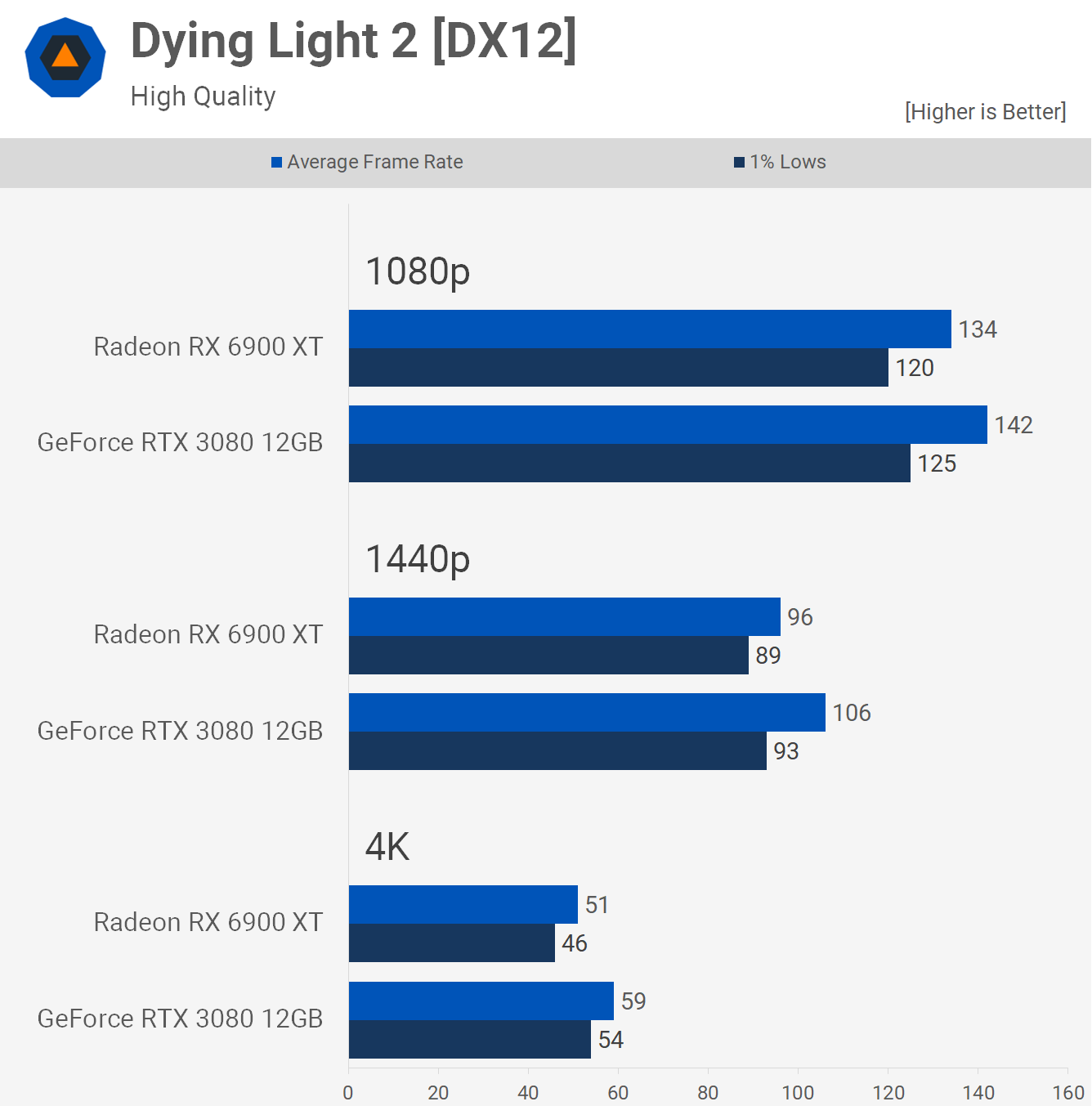
Starting time upwardly we have the new Dying Light 2 survival horror championship. For those of you targeting lower resolutions, both GPUs pushed well over 100 fps at 1080p and around 100 fps at 1440p. The RTX 3080 12GB was 6% faster at 1080p and 10% faster at 1440p, so a reasonable performance advantage. Where you're really going to find that gap though is at 4K, where the GeForce GPU offered a 16% performance bump, producing a ~60 fps experience.
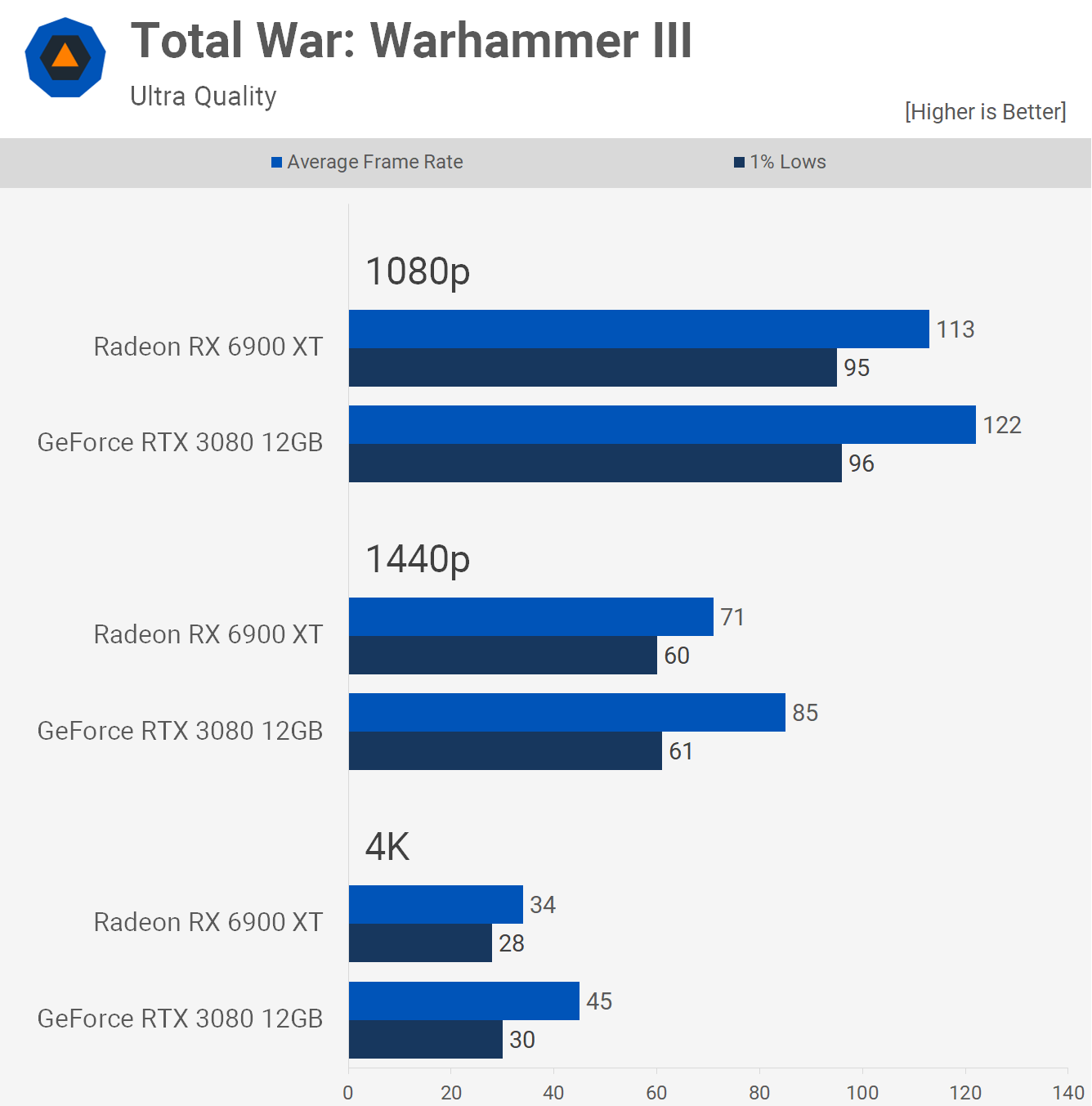
For testing Total War Warhammer III we're running the built-in benchmark using the Boxing scene and this is another new game that plays better on Nvidia hardware.
Here the RTX 3080 12GB was eight% faster at 1080p, 20% faster at 1440p, and a massive 32% faster at 4K. This is an piece of cake win for the GeForce GPU and information technology will exist interesting to see if AMD manages to claw dorsum any operation with future driver releases.
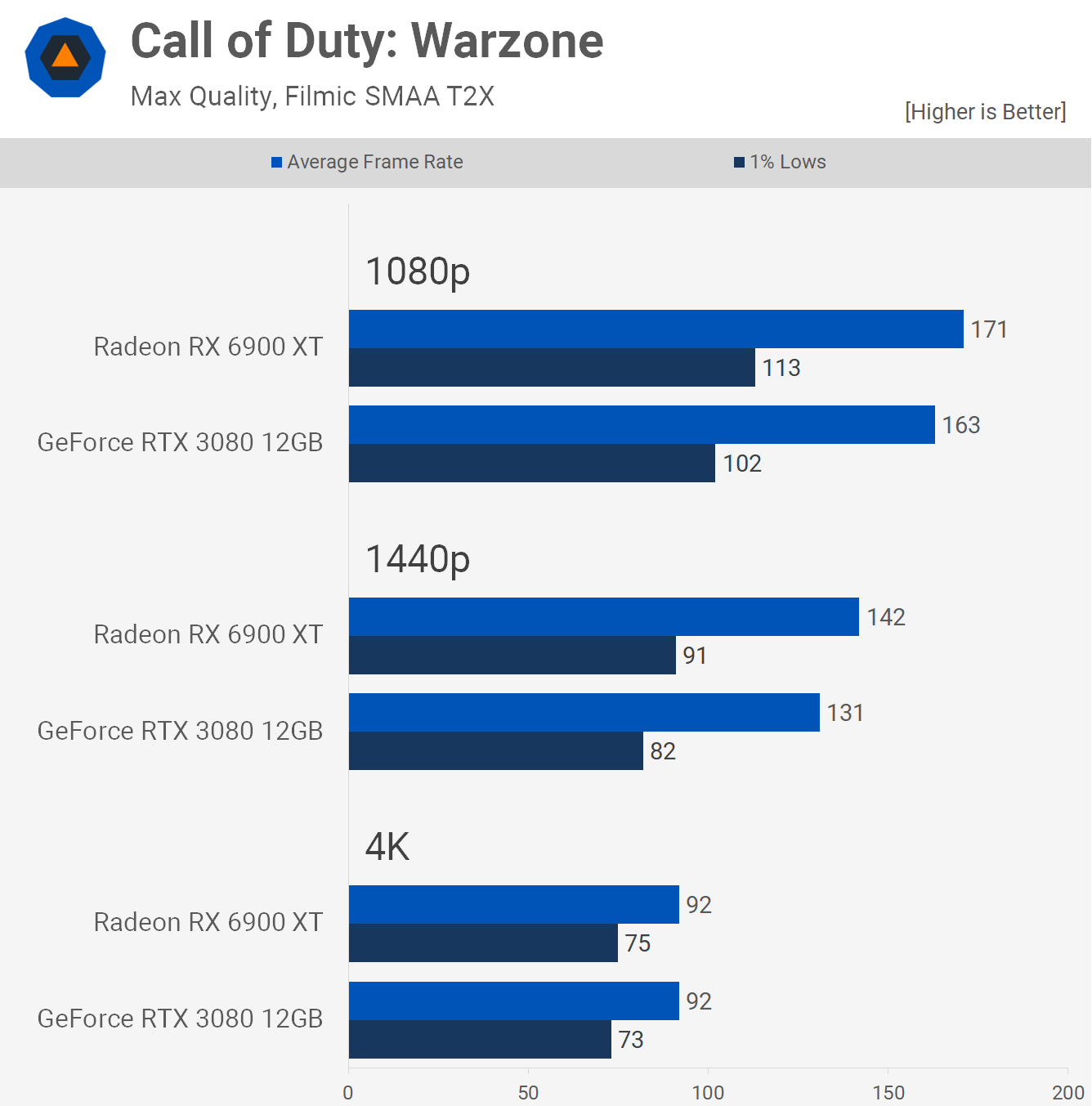
Adjacent we have the ever popular Call of Duty Warzone and for this one, like about of the games tested, we're using the highest quality settings. Despite that both GPUs pushed upwards well over 144 fps on boilerplate at 1440p, this time the Radeon GPU came out on top, though we're talking virtually a minor five% performance reward.
Interestingly, that reward was expanded slightly to viii% at 1440p, probably due to the game becoming less CPU jump. At 4K where the Ampere architecture is ofttimes better utilized, the 3080 comes back to match the 6900 XT with 92 fps.
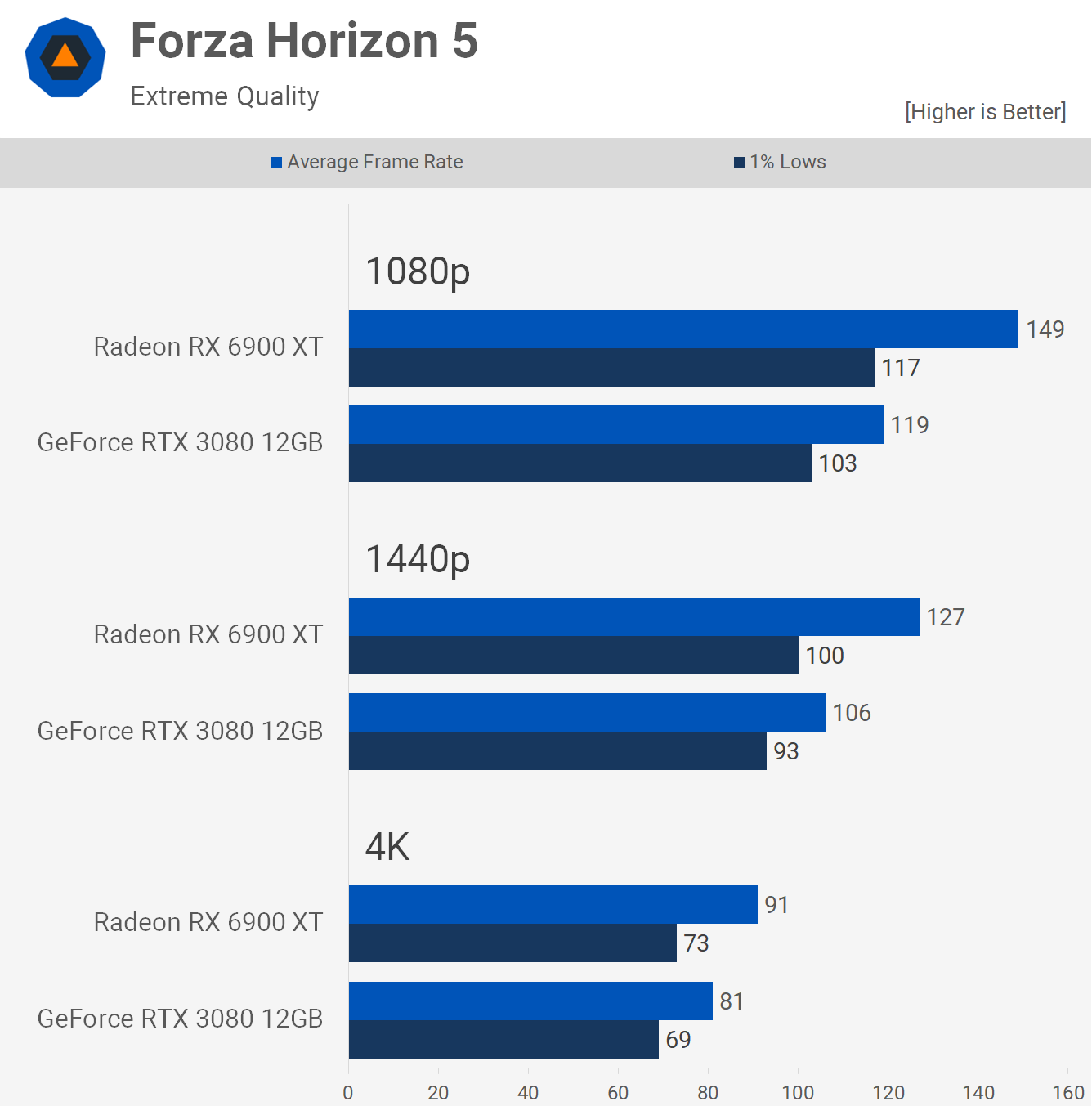
Moving on to Forza Horizon 5, the 6900 XT pulled well alee at 1080p with an impressive 149 fps on boilerplate making information technology 25% faster. That margin was reduced slightly at 1440p, but withal the Radeon GPU was however 20% faster, which is a pregnant margin.
AMD was able to maintain their advantage fifty-fifty at 4K, and the extra 12% you go out of the 6900 XT will be noticed past some gamers.
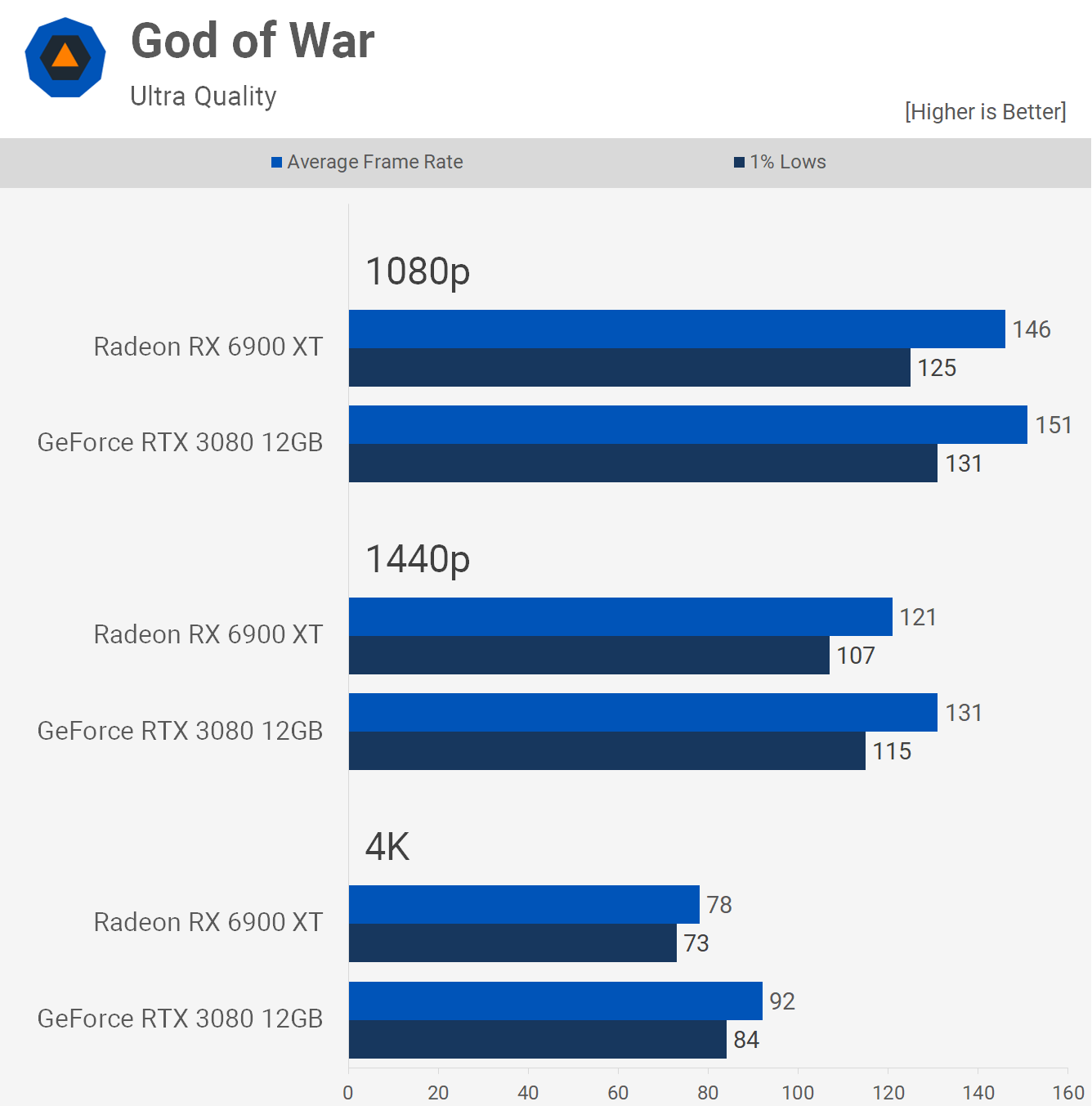
Some other new game nosotros have for testing is God of State of war and this is a gorgeous looking game. Despite the breathtaking visuals, information technology runs really well on modern high-cease PC hardware, even at 4K where the 3080 was adept for 92 fps on average, making it 18% faster than the 6900 XT.
That's a big win for Nvidia, though the 6900 XT all the same delivered highly playable functioning at this farthermost resolution with 78 fps.
The GeForce GPU provided stronger operation at 1080p and 1440p, though the margins here are heavily reduced to single-digit figures and both rendered well over 100 fps.

Next we have Far Cry vi and unfortunately this lightly threaded game is very easy to CPU bottleneck at lower resolutions when using loftier-end GPUs, as seen here. This is why the 1080p and 1440p results are similar with a very small fps boost from 1440p to 1080p.
Moving to 4K, where the game starts to become GPU leap, the 6900 XT was 12% faster with 84 fps on boilerplate compared to 75 fps with the RTX 3080. Needless to say, both produced highly playable operation.
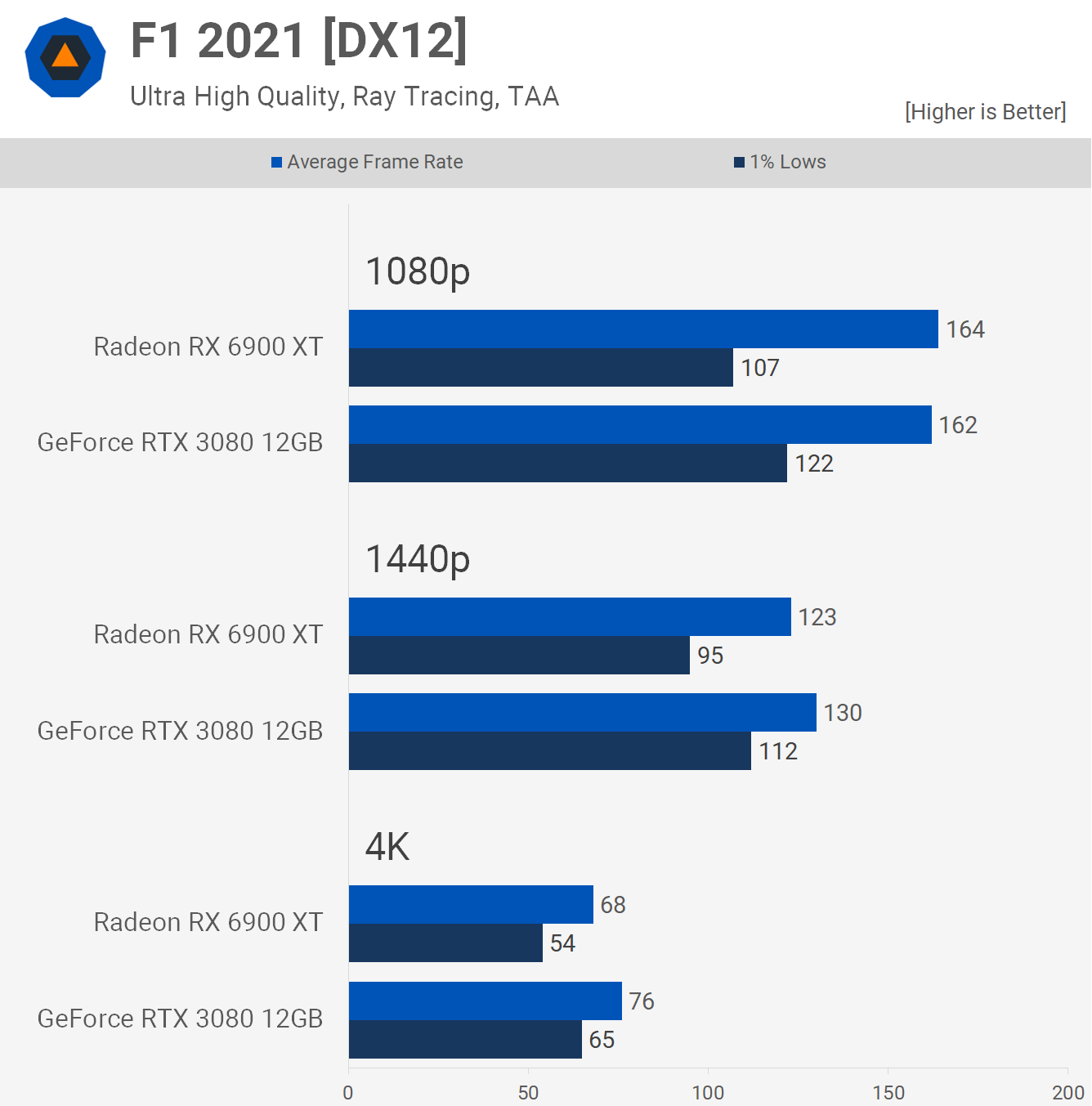
F1 2021 was tested using the ultra loftier quality preset which enabled ray tracing when supported, then both the RTX 3080 12GB and 6900 XT were tested with RT effects enabled. As we've found in the past with this title, the one% lows are lower with Radeon GPUs, though the departure is hardly noticeable when gaming.
It'due south impossible to tell which GPU you're using, peculiarly at 1080p and 1440p. The 3080 was 12% faster at 4K which is a noteworthy improvement and I'm sure some gamers will be able to spot/experience the departure, but overall they are very similar.
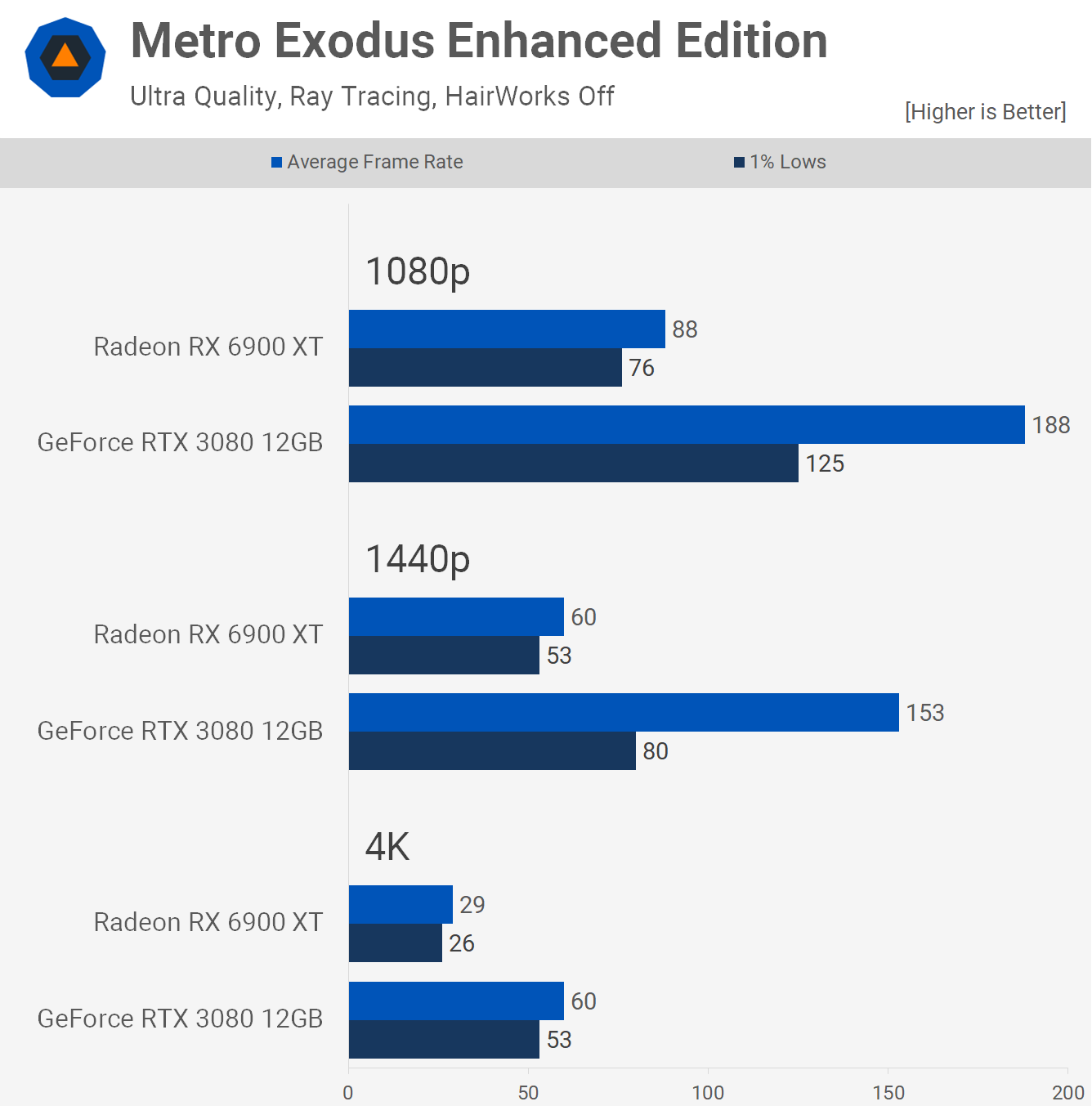
Metro Exodus Enhanced was designed to showcase RTX features and was developed before AMD'south RDNA2 architecture was bachelor, and then unsurprisingly it doesn't run very well on Radeon GPUs. This version of the game only works with hardware that supports hardware accelerated existent-fourth dimension ray tracing, and we're testing with the ultra preset enabled.
The 6900 XT is capable of playable performance at 1080p and 1440p, but at 1440p yous're looking at 155% greater performance with the RTX 3080. Then for those wanting to play this championship at 4K, yous can get around 60 fps with the 3080, while the 6900 XT falls short of even 30 fps.
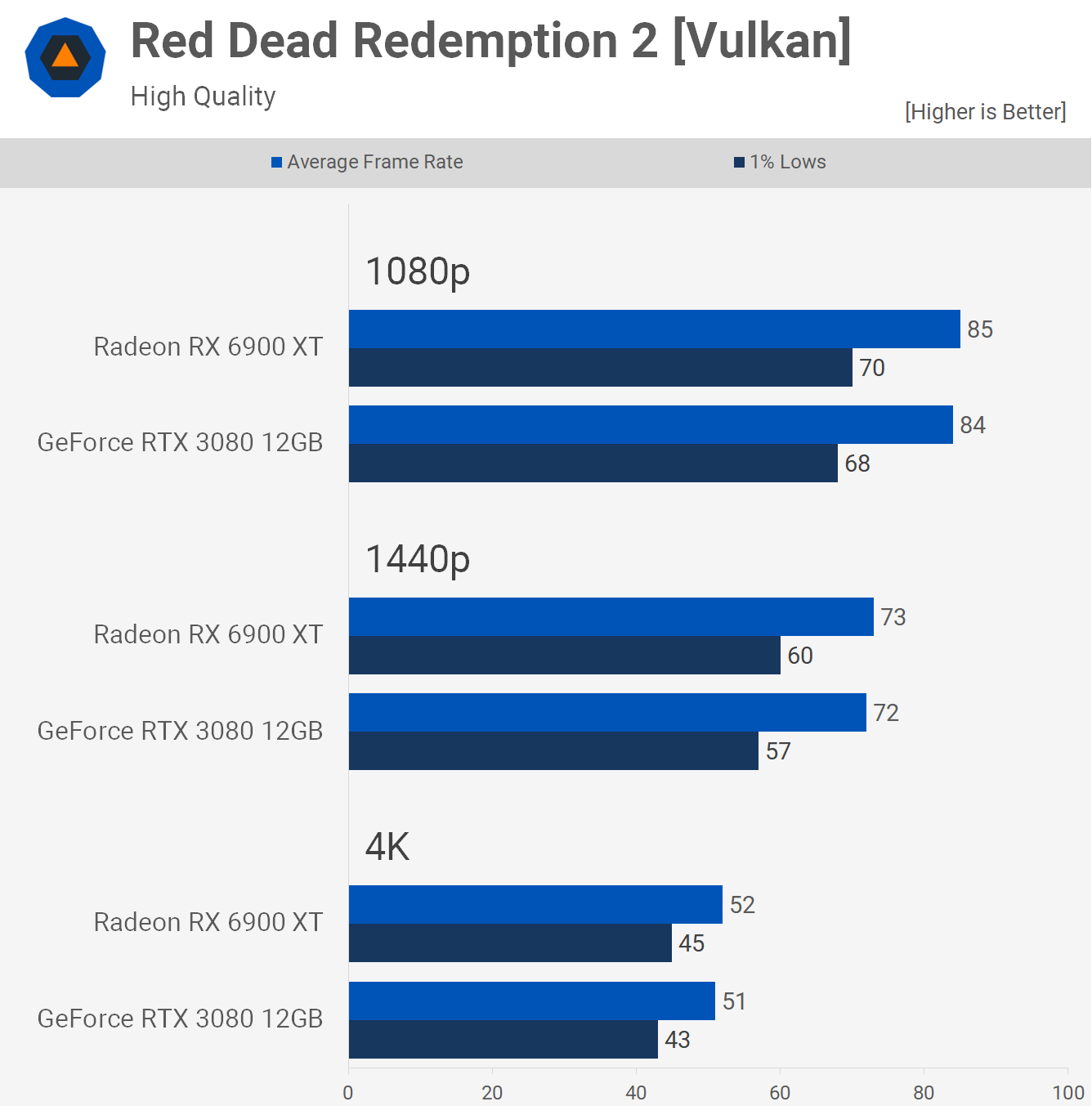
Adjacent we have Red Dead Redemption two and this championship has been well optimized for both AMD and Nvidia hardware. As a result we're looking at near identical functioning.
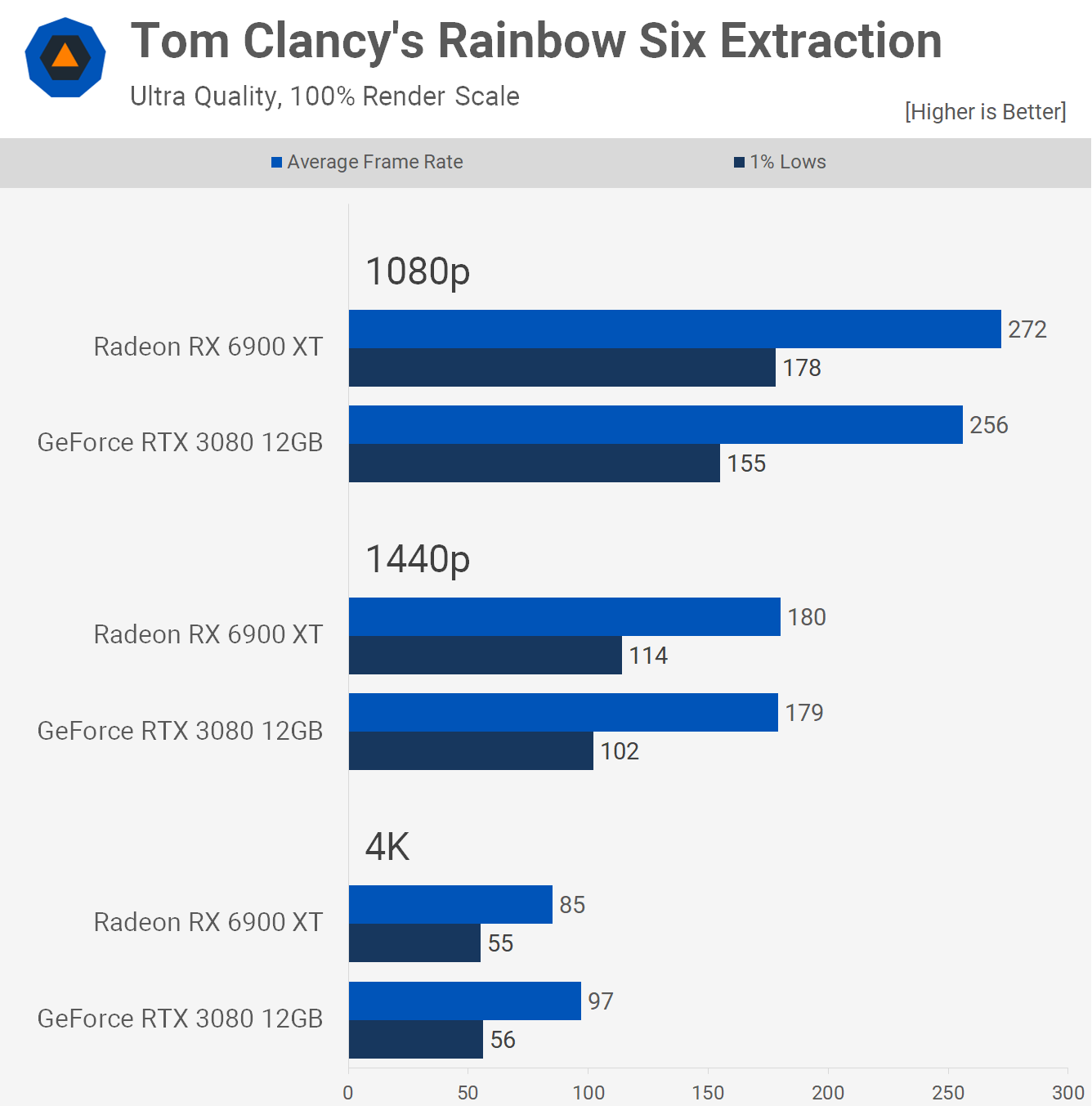
Some other newly released game, Rainbow Six Extraction is well optimized for AMD and Nvidia hardware. The 6900 XT enjoys a small performance advantage at 1080p, we then see like operation at 1440p, while the GeForce GPU pulled alee past a reasonable margin at 4K, though the ane% lows were comparable.
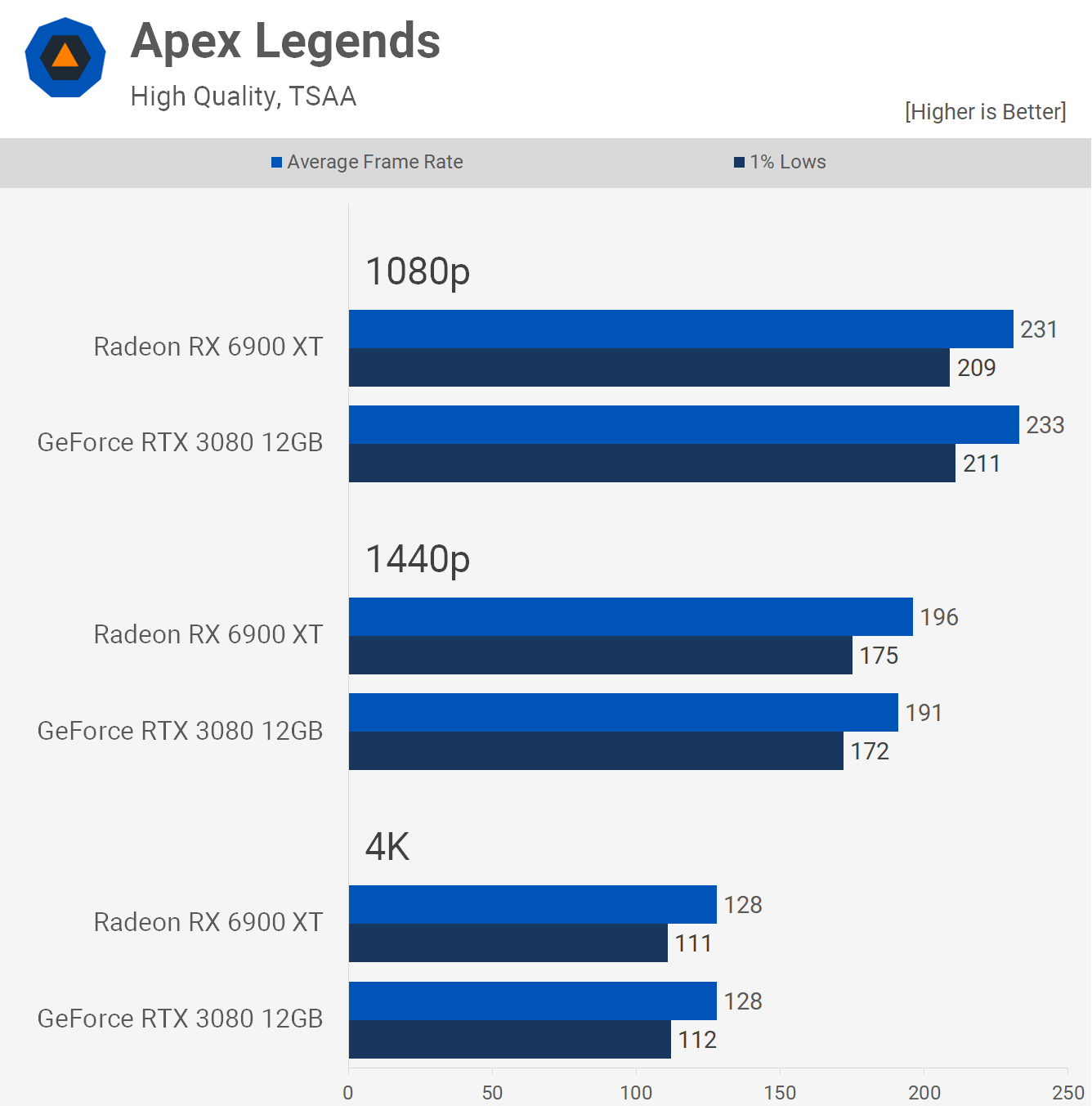
We're also looking at nigh identical performance between these 2 GPUs in Noon Legends, and with the highest possible quality settings in identify, both easily pushed upwardly over 100 fps at 4K.
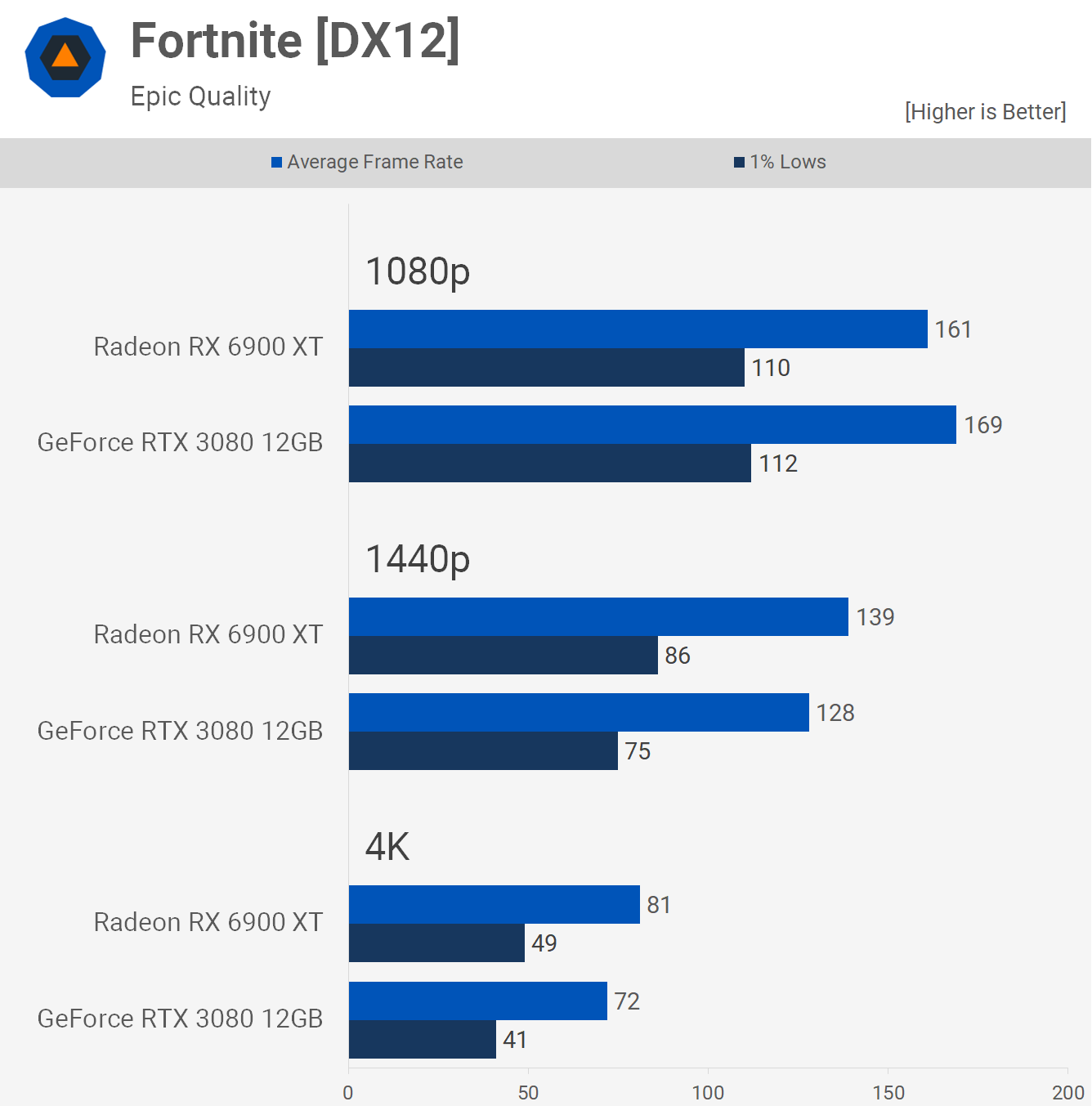
The Fortnite results were a bit unexpected every bit the 6900 XT was really slower than the 3080 at 1080p, all the same faster at 1440p and 4K. Admittedly the margins aren't huge in either direction, though the thirteen% increase at 4K isn't insignificant. For those of you lot using more competitive type quality settings, either of these GPUs should be able to push well over 100 fps at 1080p.
The 3080 tin also do good from DLSS back up, though we don't include those numbers as they'd need to be accompanied by a detailed visual analysis. Even so if you lot play a lot of Fortnite, DLSS would exist a selling indicate for the RTX 3080 12GB.
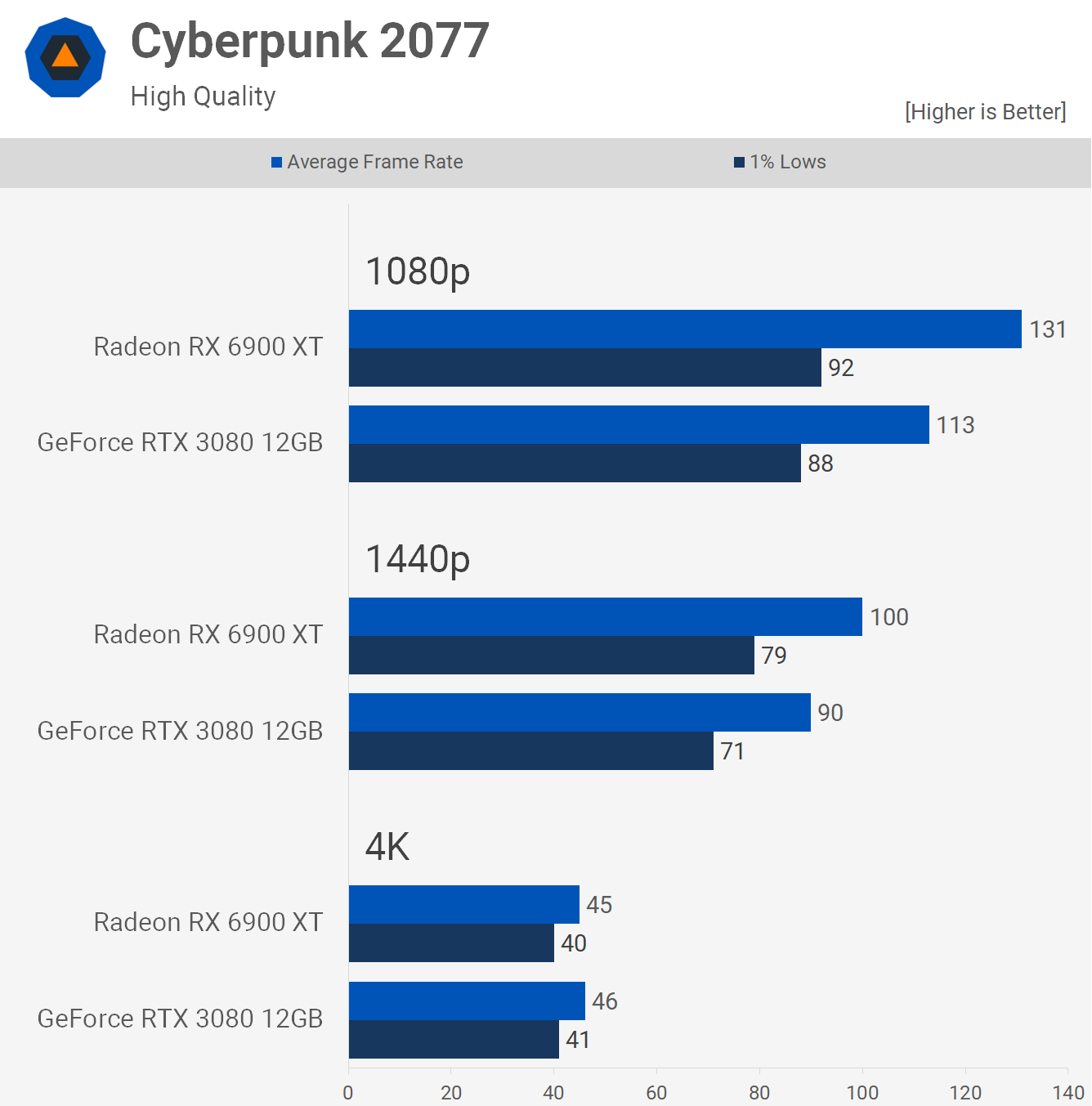
Terminal upward, hither's a look at Cyberpunk 2077 and please note for this game we're using the second highest quality preset, without any ray tracing effects enabled. Upscaling techniques such as DLSS and FSR haven't been enabled, because nosotros would accept to judge visual quality for each GPU at each tested resolution to arrive apples to apples.
Nether these test atmospheric condition, the 6900 XT is 16% faster at 1080p and then 11% faster at 1440p, while the margins are neutralized at 4K with both GPUs rendering ~45 fps. Ideally for gaming at 4K you'll want to enable DLSS or FSR, or lower the quality settings further.
fifty Game Average
Based on the dozen or and then games nosotros just looked at, the RTX 3080 12GB and 6900 XT appeared evenly matched for the most part. Only before we draw whatsoever performance related conclusions, let's take a look at the information across all 50 games tested...
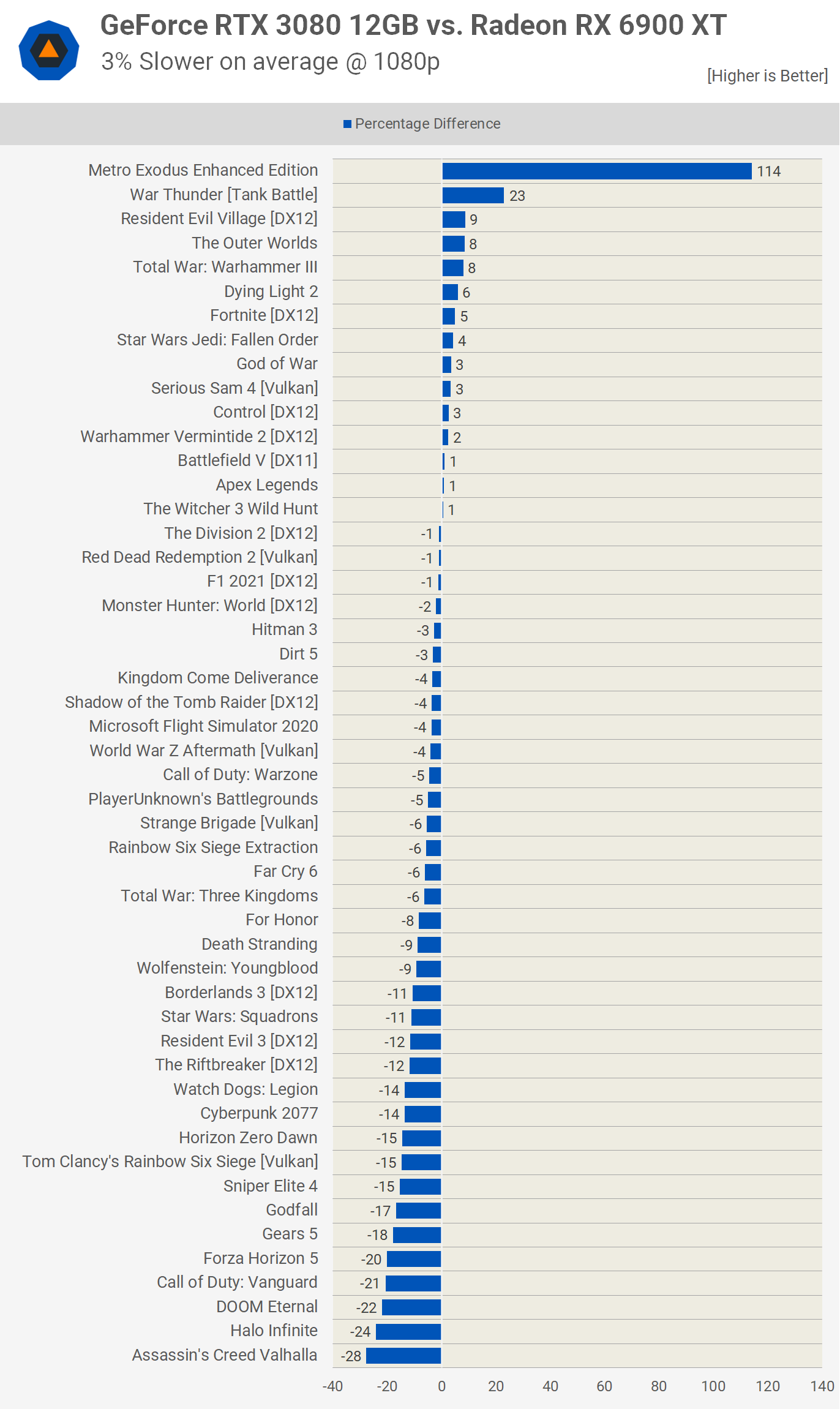
Starting with the 1080p results, we see that the RTX 3080 12GB was only iii% slower on average, significant the 6900 XT was typically faster and there were merely 7 games were the 3080 was faster by a 5% margin or more, with 25 games where it was slower by a 5% margin or greater.
Of class, the farthermost outlier here is Metro Exodus Enhanced Edition and not all of you are going to want to play that game, or are fifty-fifty interested in ray tracing at this bespeak in time.
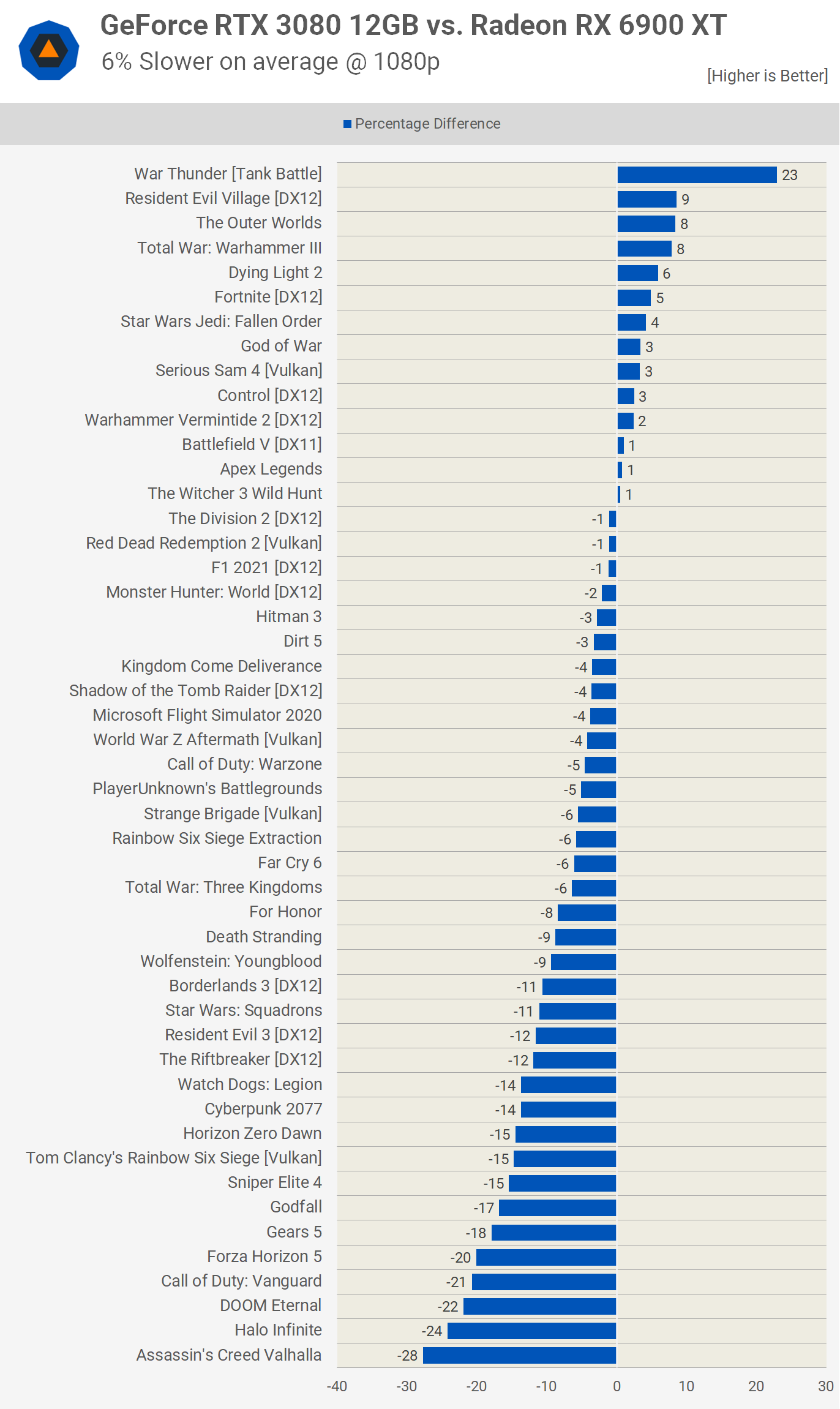
Removing that outlier does double the margin seen previously, and at present the RTX 3080 12GB is half-dozen% slower than the 6900 XT. That's still a rather insignificant margin that suggests performance is typically going to be very similar between the two GPUs, though at that place were a handful of games where the 3080 was slower by a 20 - 30% margin.
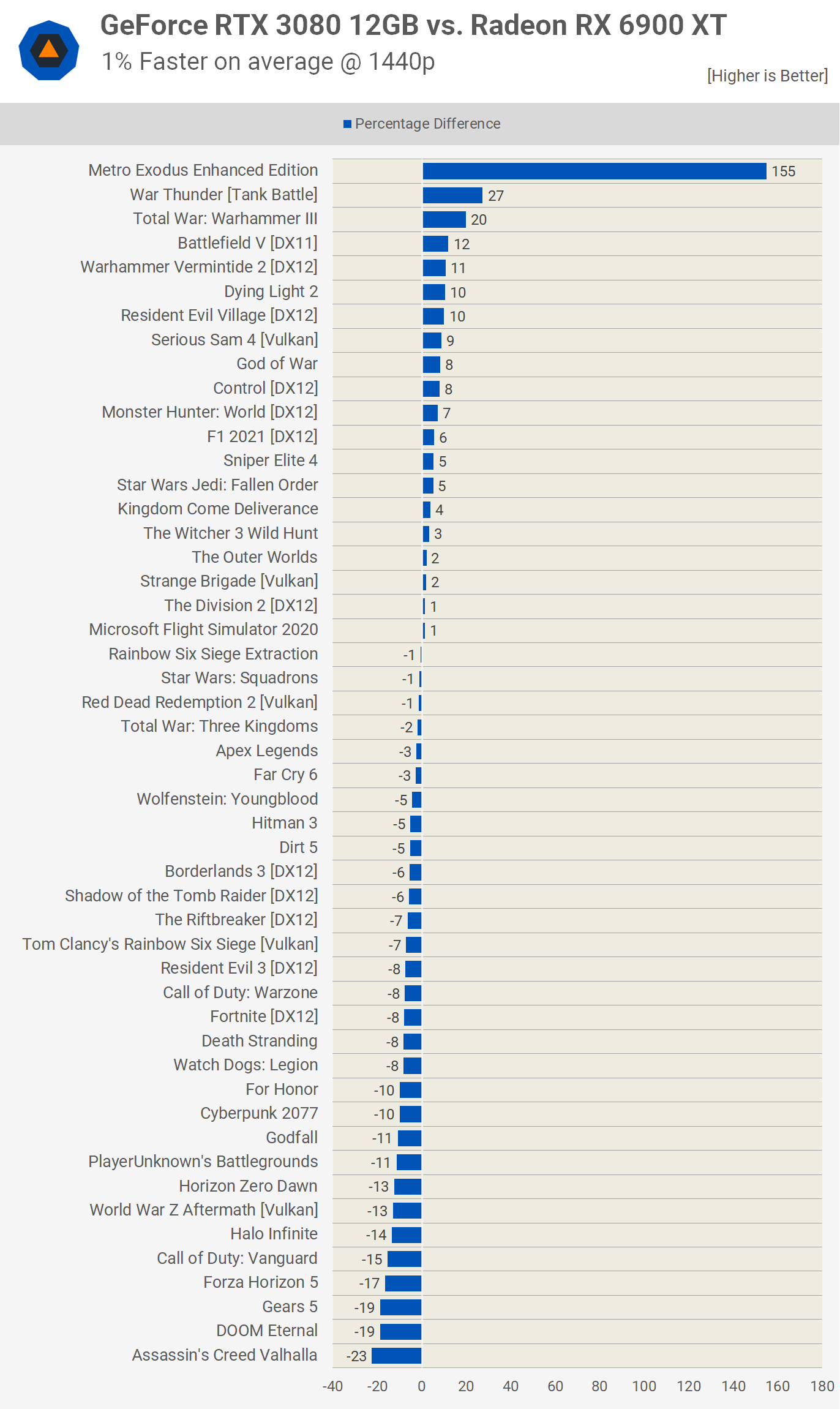
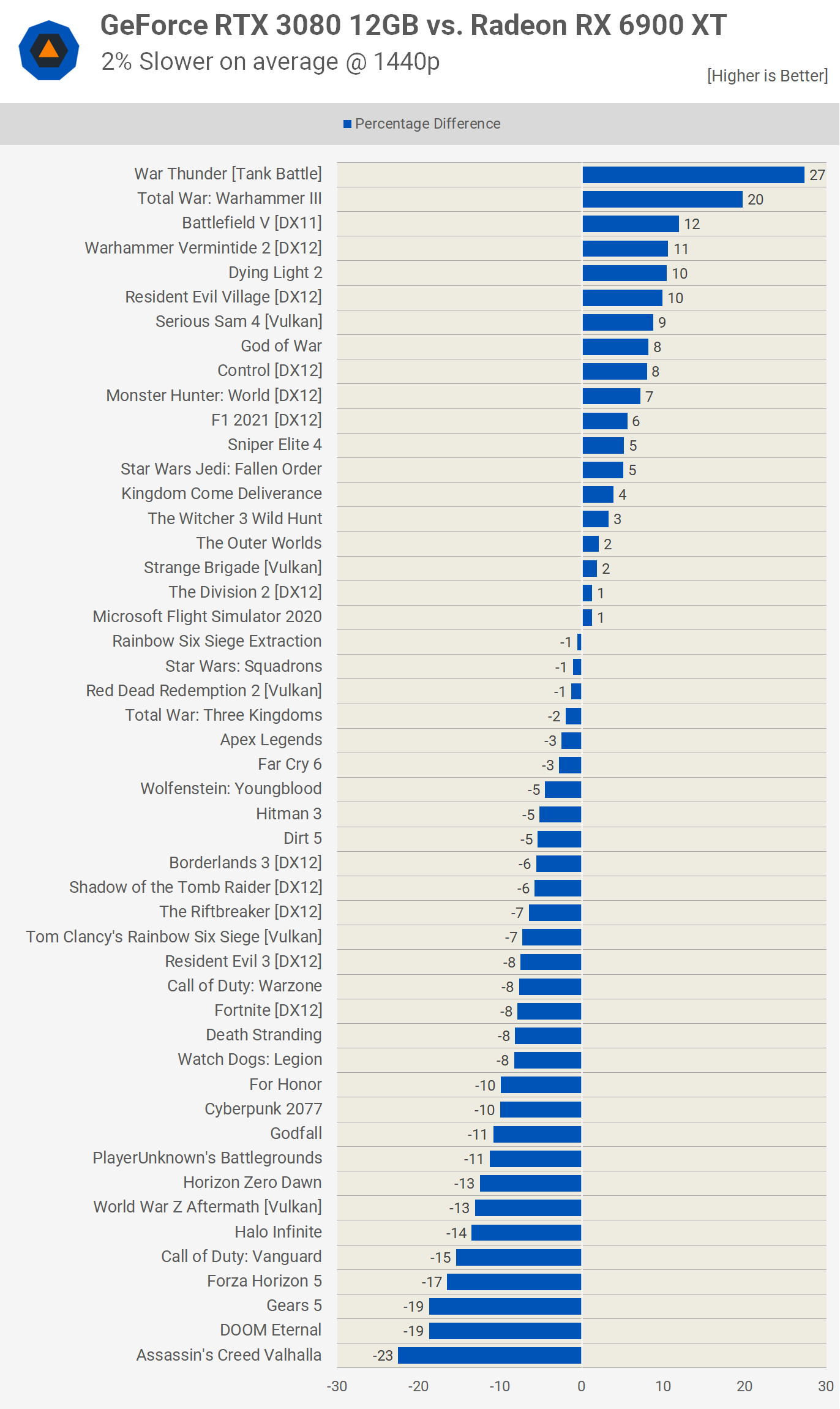
Moving up to 1440p reduces the margin further, and in fact the 3080 is now 1% faster on average when we include Metro Exodus Enhanced results. Removing Metro swung the margins effectually and at present the 3080 is 2% slower, which is a negligible margin. There were 13 instances where the 3080 was faster by a 5% margin or greater, and 24 where it was slower past a 5% margin or greater.
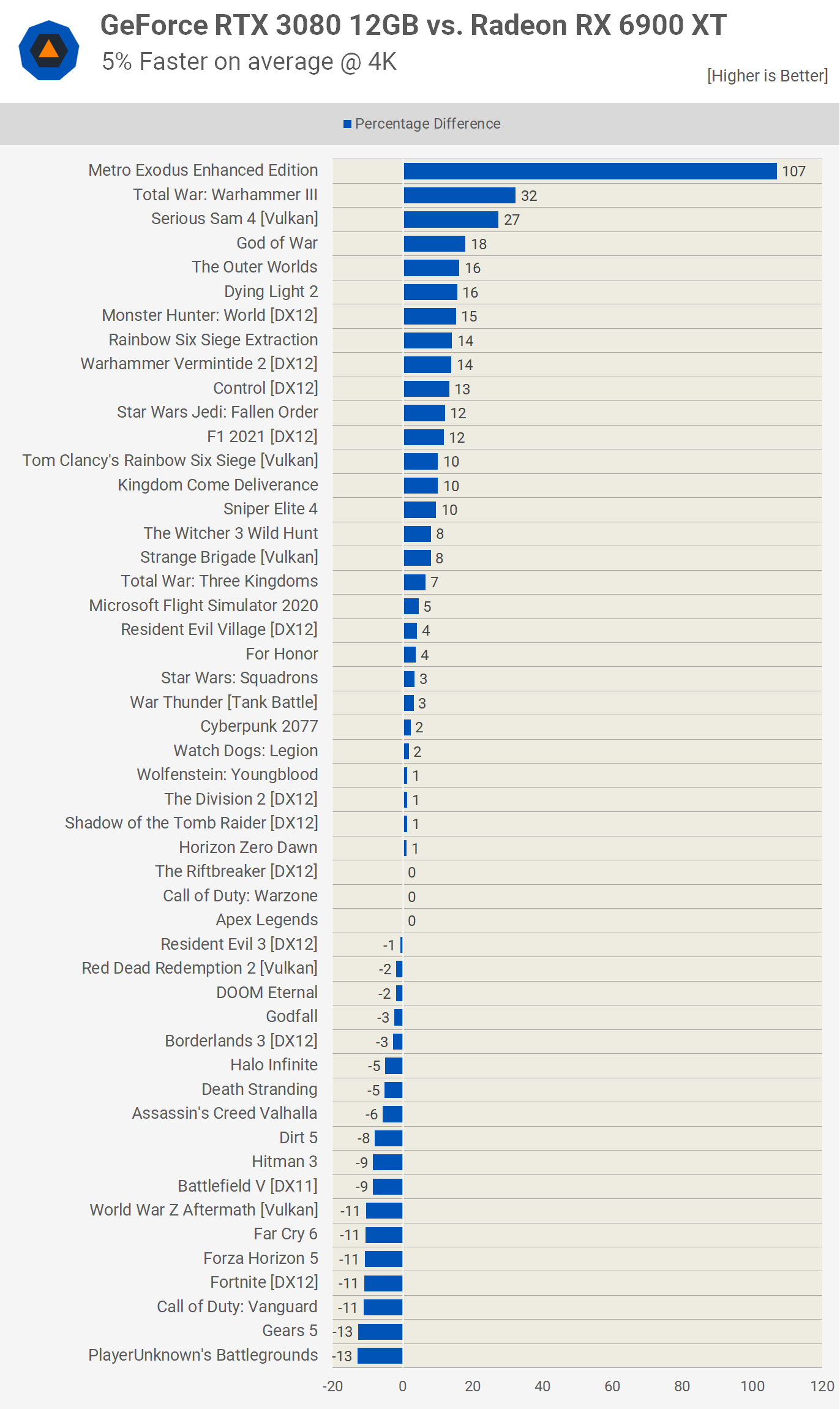
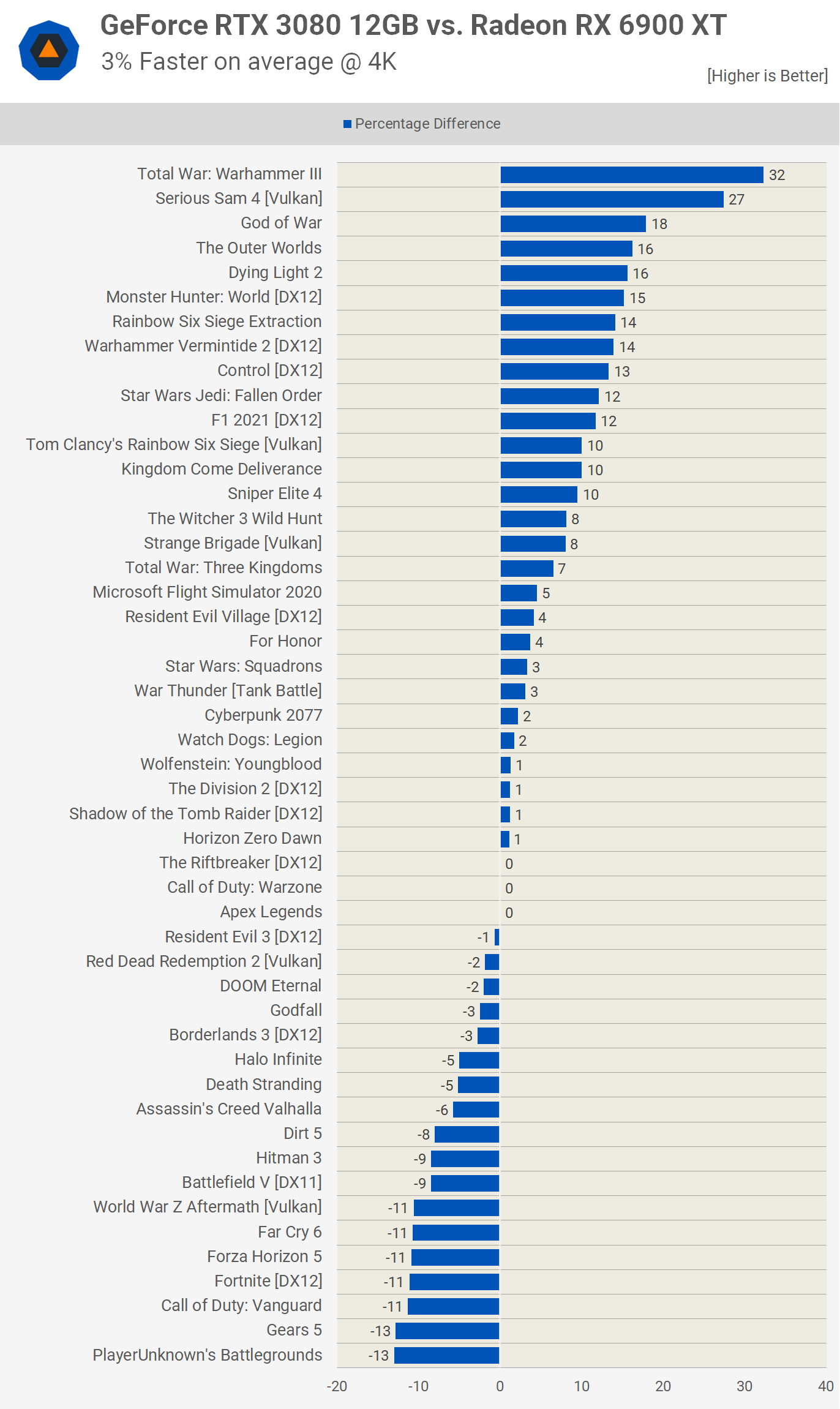
Playing games at 4K, the 3080 was v% faster on average, and typically we deem anything five% or less to be a tie. Removing the Metro Exodus Enhanced reduced the margin to three%, though we are seeing more significant wins for the GeForce GPU in titles such as Total War Warhammer, Serious Sam 4, God of War, The Outer World and Dying Light 2, for case.
Which is Better?
That's how the Radeon RX 6800 XT and GeForce RTX 3080 compare across a huge number of games, at present the question is which 1 should you lot buy? Bold you've given upwardly waiting and only want something at present...
On that note, nosotros still strongly recommend you lot proceed to hold out if you lot tin as nosotros are slowly starting to run across pricing improve as demand declines, especially from miners. But we tin't predict the hereafter, and our communication is only meant to aid guide y'all, for all nosotros know pricing could blow up next calendar week and won't recover for another 12 months, as unlikely equally that sounds.

It's also worth keeping in listen that Ampere and RDNA 2 architectures are well over a year old at this point and are expected to be replaced later this year with what should be vastly superior products. There'due south no guarantee you'll exist able to buy them this year, then information technology'southward a gamble either way.
Must read: Battle of the Architectures:
RTX 3000 vs. Radeon RX 6000
With all that in mind, if you're set up and willing to buy correct now and take a $1500+ budget, the RTX 3080 12GB and 6900 XT are available, the question is which one should you buy?

Typically, the Radeon 6900 XT is the more affordable of the two, but of course pricing varies wildly from i region to the next, and even ane day to the adjacent within the same region. Every bit it stands though, at that place's non enough of a cost deviation to make one of these GPUs the obvious choice based on pricing solitary.
Affair is though, it's the same story when looking at rasterization functioning. Surely they trade blows, merely overall information technology'south unlikely you'd exist able to spot a divergence betwixt these two products when really gaming.

This means when it comes to cost and rasterization performance, y'all tin go either way right at present... they are that similar. At that place'southward only one reason why y'all might favor the 6900 XT and that's the extra 4GB of VRAM, though it'due south hard to say when that will be of benefit. Frankly, 12GB should exist plenty for the foreseeable future and shouldn't become an issue within the realistic lifespan of this GPU generation as a high-finish gaming production.
On the other hand, the GeForce RTX 3080 12GB has the advantage of DLSS and more mature ray tracing, which generally yields far amend results. In our opinion, DLSS has become a strong selling point of RTX branded products as support and quality continues to amend. Meanwhile, AMD nevertheless doesn't have a existent reply to DLSS. Yep, FSR has helped to lessen that blow, and is quite an impressive solution in its own right, but it doesn't nullify DLSS and it's non a key selling point of Radeon GPUs, largely because information technology supports all GPUs, GeForce included.

Equally DLSS continues to improve, and so does ray tracing, with more and more than titles offering ray traced effects, and those that utilize information technology well mostly see performance tank on RDNA2 based products.
For me personally, ray tracing performance isn't a priority, but equally we've said the adoption and employ of ray tracing is always improving and I'm certainly much more interested in it today than I was even a year agone, and I await that trend to keep.

Regardless of your stance, we feel information technology's piece of cake to argue in favor of the RTX 3080 12GB given those features. In curt, if you're corking to check out ray tracing and think you'll play the latest titles with information technology enabled, a GeForce GPU is a must as performance is typically much better. We'd only get for the 6900 XT if nosotros weren't at all interested in ray tracing and it was at least a few hundred dollars cheaper.
It's also worth mentioning that all testing was conducted on a Ryzen 5000 organisation with Smart Access Memory enabled (resizable BAR), and this tends to favor Radeon GPUs more than GeForce. If your system doesn't yet support resizable BAR, the RTX 3080 12GB will look slightly better overall when compared to what'south been shown here.
Bottom line is that new technologies such as Smart Access Retention, ray tracing, and DLSS make it harder than ever to make a concise GPU recommendation, only hopefully this testing helped you narrow downwards your choice between these high-stop GPUs, whether you're ownership at present or in the nearly future when prices (crossing fingers) get closer to MSRP.
Shopping Shortcuts:
- GeForce RTX 3080 12GB on Amazon
- GeForce RTX 3080 on Amazon
- GeForce RTX 3060 Ti on Amazon
- GeForce RTX 3070 Ti on Amazon
- Radeon RX 6900 XT on Amazon
- Radeon RX 6600 on Amazon
- Radeon RX 6800 on Amazon
- Radeon RX 6800 XT on Amazon
- Ryzen 9 5950X on Amazon
Source: https://www.techspot.com/review/2420-geforce-rtx-3080-vs-radeon-6900-xt/
0 Response to "Radeon Rx 6900 Xt Ray Tracing"
Post a Comment